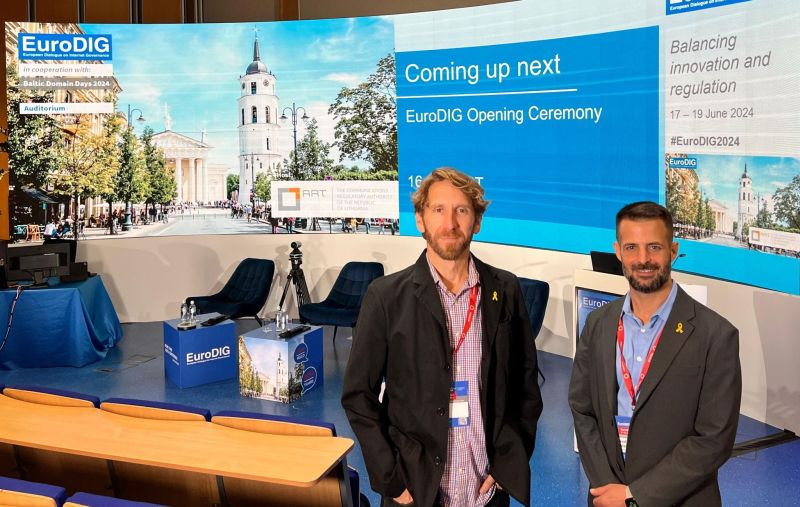
Dr. Asaf Wiener, our Vice President of Regulation and Policy, and Edan Ring, our Vice President of Community Affairs represented the Israel Internet Association this year at the 2024 annual EuroDIG – the Pan-European Dialogue on Internet Governance, held this year in Vilnius, Lithuania’s capital, from June 17-19. Hundreds of government representatives, internet researchers and experts, and social activists from dozens of EU countries and across the world gathered with the shared purpose of engaging in the challenges and opportunities that the internet presents to societies and democracies, and the desire to build a plan for managing the internet cooperatively.
EuroDIG is an open multi-stakeholder platform for the exchange of views about the internet and how it is governed.
Four main topics took center stage at this year’s conference:
- Protecting children online (and the challenges it poses to user privacy)
- Combating disinformation (primarily concerning Russia and elections in Europe)
- Ensuring internet accessibility and connection for minorities and marginalized groups
- Regulation and ethics of artificial intelligence applications in their various forms.
We saw striking similarities in internet threats and challenges shared across numerous countries, cultures, and languages throughout Europe and the rest of the world. At the same time, we noticed important disparities stemming from each country’s local characteristics and nuances, particularly on the subjects of internet law and governance. International cooperation and knowledge sharing are extremely beneficial to the development of local and shared responses to these challenges. Everyone seems to be in agreement that there is no “golden solution” in the form of one technological tool or one efficient law that could solve the problem. The response must entail systemic change across multiple channels, each complementing the others.
Alongside representatives from numerous national authorities and international organizations, civil society organizations like the Israel Internet Association stood out at the conference. These organizations play an increasingly significant role in a multi-sectoral and stakeholder-rich arena characterized by an inherent tension between the public good, the commercial interests of platforms and corporations, and the limited capacity of local regulation and legislation to contend with the borderless and territorially undefined nature of the internet. In this complex reality, civil organizations that operate on behalf of and for the sake of the public and understand the reality on the ground have substantial latitude for action and potential influence.
We left EuroDig with renewed appreciation for the positive power European collaborations have to develop knowledge and formulate comprehensive responses to threats and disinformation online, a field that is notably lacking in Israel, with few collaborations on this subject both on the national and international levels. However, we were also pleased to see that the strategies and insights that have been developed in Israel to combat harmful content and the spread of false information in recent years are not far behind those around the world. We can proudly say that we are indeed in the forefront, despite our country’s limited resources and relatively sparse governmental activity.
Despite the difficult period currently faced by Israel, and with hope for brighter days ahead, we are determined to continue proudly representing our nation on the global stage and most importantly to continue advancing our local arena, for the betterment of our shared and interconnected internet.