Among the noteworthy issues at the heart of the international discourse in the shadow of the “Swords of Iron” war is the question of control over the internet in the Palestinian Authority and the extent of Israel’s ability to shut it down. This article puts forward a professional picture of internet institution management in the Palestinian Authority, and outlines the technological-political-moral debate regarding internet supply to the Gaza Strip and the implications that arise from an “internet shutdown” during a time of emergency and combat.
Following the IDF’s initiation of ground operations in the Gaza Strip on October 26, 2023, reports of a complete internet blackout in the region began to rapidly spread through international media. This development sparked widespread condemnation. These reports did not come as a surprise. Since the onset of the conflict weeks earlier, triggered by the incursion of Hamas militants and supporters across the Gaza border into nearby cities and suburbs in Southern Israel, global entities like the Internet Society (ISOC) noted significant internet disruptions and access limitations in Gaza. Virtually all of the reports pointed an accusatory finger at the State of Israel who had, by all appearances, deliberately caused this internet shutdown in the Strip.
This article aims to establish a factual and institutional context for the global discourse on morality and internet governance in the Palestinian Authority, specifically in view of the extensive internet outages in Gaza amid the October 2023 war efforts. Section A offers a concise history of how the Palestinian Authority’s national virtual identity developed and of the entities formally overseeing internet management within its territory. Section B uncovers the complexities in recognizing the PA’s effective control over its internet infrastructure, especially given the documented disconnections and lack of web access in Gaza during the “Swords of Iron” conflict. Section C delves into moral considerations and the widespread international belief that internet access is a fundamental human right. Here, the discourse includes diverse opinions advocating for immediate restoration of internet services in Gaza for humanitarian reasons, countered by arguments emphasizing the military intricacies involved and the internet’s exploitation by terrorist factions. Section D clarifies the concept of an “Internet Shutdown,” a pivotal term in the moral and technological discussion, defining global web usage and user rights. Comprehending this term situates the debate within a broader historical and international framework. Lastly, Section E proposes a foundation for in-depth exploration and balanced consideration of diverse, conflicting perspectives about the ramifications of internet denial during conflicts, particularly given the internet’s utilization by terrorist groups against both civilian and military targets.
A. The link between borders and technology: the formation of internet institutions in Gaza
While the internet was once perceived in the 1990s as a “medium that challenges the nation-state,” it is “already difficult to think of the web as a global medium without addressing aspects of regulation, governance, and control by nation states”.[i] Over the past two decades, the Palestinian Authority[ii] has undertaken steps to gain international recognition of its sovereign identity in cyberspace. A significant milestone was achieved in 2003 when the PA was assigned the state domain name “.ps” by ICANN. [iii] This move was groundbreaking as it offered formal international recognition on the internet to a political entity without universally agreed geographical borders, even though it had not received official recognition as a state by the broader international community. [iv] In 2011, further asserting its digital presence, the Palestinian National Internet Naming Authority (PNINA) registered the Internationalized Domain Name (IDN) فلسطين (Palestine).
Since 2003, the Palestinian Authority’s country code Top Level Domain (ccTLD) has been managed by PNINA. As of the beginning of 2023, 73 Palestinian registrars were active within this entity, alongside an additional 26 international registrars.
Alongside PNINA, another organization responsible for internet governance in the Palestinian Authority is PIX, the managing and operating entity for the Palestine Internet Exchange Point. The Palestinian internet exchange, located at Birzeit University in Ramallah in the West Bank, was established in coordination with the Palestinian Minister of Telecommunications and Information Technology and with the support of various local and international organizations, with international ISOC being chief among them. Unlike Israel, where the Israel Internet Association is charged with managing the domain name registry as well as the Israel Internet Exchange (IIX), the Palestinian exchange is operated by ISOC-PS (https://isoc.ps), whose managing committee includes a small number of PNINA representatives. It appears that most members of the managing committee of ISOC-PS (and in practice–of the exchange) are appointed by the global Internet Society.
In addition to recognition in the international domain space, in 2010 the social network Facebook recognized the Palestinian Authority as a registered state on the platform. That year, Google granted the PA Google.ps, a designated local service supplied by the company.[i] Ben-David and Lavie explain that Google’s decision to recognize Palestine entrenched the company’s status as a technological economic powerhouse that could face nation states such as Israel and the United States, and that these moves were actually the Palestinians’ first steps toward attaining control over the communications media in the PA, alongside international recognition in cyberspace:
“Despite the media storm, Google’s recognition of ‘Palestine’ is not surprising. After establishing autonomy following the Oslo Accords, the Palestinians attempted to move beyond the Palestinian Authority’s non-sovereign borders by founding a sovereign technological space […] From Israel’s standpoint, these decisions violate the Oslo Accords, which stipulated that discussion of the Palestinian Authority’s control over international communications points would be postponed to the final status agreements, according to the borders to be set in the future. Yet, two decades after the Oslo Accords, the possibility of reaching a final status agreement seems more distant than ever.”
The following words were written back in 2013 and appear even more pertinent a decade later, especially in the current climate: “Therefore, it can be estimated that, in a state of political stalemate, the Palestinians would seek to further expand their independence in the telecommunications and cybernetic space.”[vi]
B. The question of control over the PA’s physical internet infrastructure and its resilience during wartime
While recognition of Palestine’s virtual identity, as well as its progress in establishing bodies and resources for internet management in the PA, are indeed milestones in its quest for technological sovereignty, in practice this is clearly not enough. Although the web is global and is ostensibly “intangible”, the transmission of information on the web is very physical. The expansive worldwide web is comprised of cables that run underneath the seas, crossing continents and connecting them to generate information traffic to and from every corner of the Earth, as well as local cables that connect domestic networks owned by various civilian, private, and state bodies. That is to say, in practice every entity (private or state) needs a physical connection in order to access the internet.
As explained by Dr. Dima Epstein, researcher of internet governance from the Department of Communication and the School of Public Policy and Governance at Hebrew University, in a special episode of the Israel Internet Association’s podcast, Gaza does not have an independent internet connection and it relies on a connection to Israeli infrastructure, and probably to the Egyptian network as well. To the best of our knowledge, the Palestinian Authority does not own submarine communications cables or a lease that would grant it access to such a cable in order to connect to the worldwide web.
However, as of 2022, approximately 90% of Palestinian households have internet access, and about a third of them have a computer. In the PA as a whole (Gaza and the West Bank), 405,000 broadband ADSL connections were recorded as of this date. The internet infrastructure and connections in Gaza are supplied by numerous Israeli and Palestinian entities, including the Palestinian telecommunications companies Paltel and Jawwal.
Since the breakout of the war following the brutal Hamas attack, reports from around the world pointed to the gradual collapse of the web in the Gaza Strip to the point of almost complete stoppage – beginning with a drop to 20% connectivity on October 7, 2023, a continued drop to 15% or less on October 21, and reports of almost complete stoppage on October 27, after which connectivity was partially restored and has continued to fluctuate up until the writing of this article.
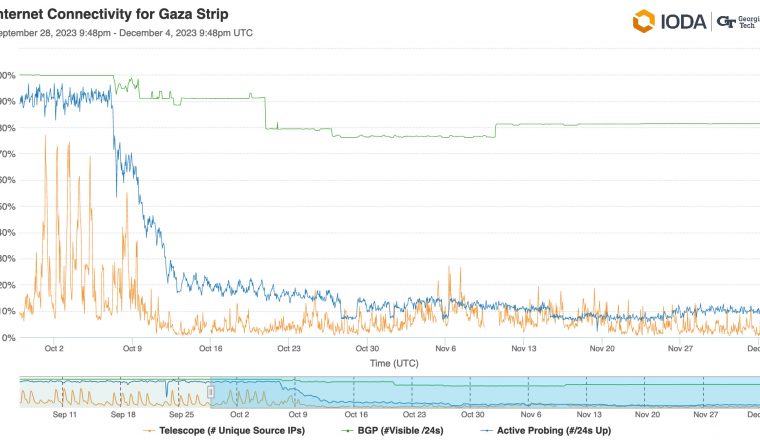
The estimated causes of this disruption are the physical destruction of infrastructure elements and connections on the ground due to bombing, a shortage among local suppliers of the diesel fuel needed to produce the necessary electricity for service operation, and even deliberate shutdown by the State of Israel for the purpose of preventing terrorist activity during the IDF’s ground maneuvering in the Northern Gaza Strip. Since from what we know Israel holds a point of access through which at least part of the Strip’s connection to the internet is executed, we can presume that it could theoretically be disconnected, partially or fully, by government order. Even still, the evidence supporting the actual utilization of this power is weak at best. ISOC Pulse cites only a statement issued by the Israel Ministry of Communications indicating that it was examining the possibility of doing so, and an anonymous U.S. official who asserted with supposed certainty that Israel had temporarily shut off communications, though these claims are not corroborated by any reliable, identified source.
C. How does an international-technological-moral debate get entangled in a web of war and terrorism?
At the center of the international debate stands the question – is the absence, and even intentional prevention, of internet access a real and material violation of civil rights? In other words, is an internet connection a basic right just like access to water, electricity, and medicine? The debate becomes particularly acute when it is positioned within its present context – continuous combat in the region. Epstein clarifies that the more our reality and existence become intertwined with the internet, the more pervasive the perception of internet access as a human right becomes, and although Israel ostensibly disconnected the internet within the context of a military operation, the discussion concerning internet supply has been exclusively focused on the civilian dimension of the issue.
The Internet Society (ISOC)’s policy brief from 2019 explains the economic, technical, and human rights implications of an internet shutdown. The brief clarifies, for example, that according to the UN’s view, prevention of internet access is disproportionate harm, in violation of Article 19, Paragraph 3, of the International Covenant on Civil and Political Rights, regardless of the justification given by the entity that ordered and acted to execute it. The UN also calls on all states to “ensure that Internet access is maintained at all times, including during times of political unrest”. But is “political unrest” equivalent to cross-border combat? Connectivity in battle zones is a complex matter and in Gaza, whose political-sovereign status has not yet been finalized since the Oslo Accords and is seemingly subject to a certain degree of Israeli control over internet supply into its borders, the question becomes even more complex.
Throughout the world, there have been those who protested at the injustice committed against civilians in Gaza and emphasized the problems inherent in the absence of internet access, which isolates these civilians from the external world and prevents them from communicating with their relatives or using other online services. Joining the voices of international rights organizations like Access Now, Democratic US Congresswoman Alexandria Ocasio-Cortez publicly appealed to Elon Musk, owner of X (formerly Twitter), Tesla, and other companies including the internet company Starlink, and asked him to help civilians in Gaza reinstate connectivity, as he had done in Ukraine. Musk agreed and announced that he would help Gaza, but it is unclear whether this was feasible to begin with.
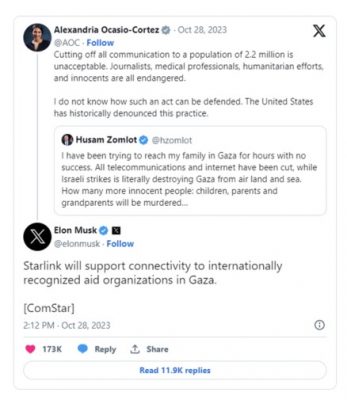
As detailed by Epstein, most of the major internet infrastructure responsible for global communications runs undersea, entailing costly installation and maintenance. This poses technical and economic difficulties, in response to which satellite communications alternatives have been developed. While in the past satellite technology was also considered cumbersome and costly, since the satellites did not supply service to large enough regions, there is now technology that can position satellites in close proximity to Earth, producing low Earth orbit satellite infrastructure (LEO), which supplies quick and relatively inexpensive communications. Businesspeople like Elon Musk (Starlink) and Jeff Bezos (Project Kuiper) deploy small satellites at a relatively low distance from Planet Earth, which enable a relatively low-cost internet connection even in disconnected areas. However, connection to these satellites requires an access point on the ground, an antenna, which provides connectivity to end users. In Ukraine, Musk donated numerous Starlink docking stations to reconnect the country to the internet, and reports published on this topic showed that these stations contributed greatly to connecting Ukraine’s citizens to communications during wartime.
Israel’s Ministry of Communications has been in contact with Starlink to “coordinate activity” since the period preceding the war, as part of the company’s gradual expansion throughout the world. The connection and operation of terminals in Israel was scheduled to take effect in 2024. During the first weeks of the war, the Ministry of Communications sought to advance the engagement with Starlink and position terminals just outside of Gaza for use by the towns in the first line of fire. In response to Musk’s declaration regarding internet supply to Gaza Strip residents during the war, Israel’s Minister of Communications, Shlomo Karai, expressed strong criticism and warned that these internet services would also serve terrorist elements. Musk responded that use of the satellite connection would be subject to supervision which would prevent access by terrorist elements and expressed a willingness to cooperate with the Israeli authorities and defense forces regarding placement of the terminals. As of the writing of these words, Starlink satellite operations in Israel have yet to be arranged. Although one of the company’s terminals has been stationed in Moshav Ein Habesor in the Lakish Regional Council, its use has been blocked by the Ministry of Communications, citing the ongoing process toward the service’s licensing in Israel.
Meanwhile, many reports have demonstrated that the Palestinians have been using alternative methods to access the web, and the disconnection does not appear to be complete, in contrast with the claims of digital human rights organizations. For example, there are testimonies of end user internet connections using an eSIM or using foreign infrastructure such as Egyptian telecommunications towers.
Considering the above, the various reports, the empirical data, and the moral and technological debate hinged on speculation and ideological claims, raise substantive questions about internet access and prevention during wartime. A central concept in this debate, referred to by many voices associated with organizations that advocate for internet rights, is that of the “internet shutdown”. An understanding of this concept helps to view the present discussion within its international context, providing insight into the political and global framing of this technological phenomenon.
D. What is an internet shutdown?
An “internet shutdown” is the practice of preventing full or partial access to the internet in a particular geographical area, often initiated by governmental authorities, usually while presenting a justification for the action, stemming from reasons that are political or connected to national security. According to the definition of the digital rights organization Access Now, an internet shutdown is an “intentional disruption of the internet or electronic communications rendering them inaccessible or effectively unusable, for a specific population or within a location, often to exert control over the flow of information”.
Internet shutdowns are a familiar phenomenon in countries like India, Iraq, and Iran. The term appears frequently in public discourse in the context of the complex debate over internet freedom, connectivity, and civil rights like equality and freedom of information. According to ISOC, the global phenomenon of internet shutdowns began to gain attention in 2011 when, during the “Arab Spring” protest wave, the internet was shut down in Egypt for almost a week, with the objective of disrupting communications by protestors and activists. In the years that have passed since, the use of internet shutdowns by governments for political objectives of various kinds has increased consistently. According to data from Access Now, in 2020, 159 internet access disruption events occurred throughout the world, in 2021 – 184 events, and in 2022 there were 187 such events. ISOC documented 119 shutdown events during 2023.
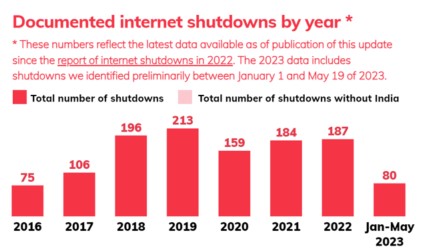
Internet shutdowns are not limited to prevention of access to social networks or of connection to private internet, rather they also deny the use of other local online services, such as location services, online medical services, or interpersonal communication through instant messaging apps.
In the present context it is important to understand that, from a technical standpoint, it is impossible to separate internet access by terrorist organizations from civilian internet access. Therefore, a humanitarian question arises regarding the prevention of internet access – a basic resource in the 21st century – particularly with respect to a region where a terrorist organization operates, and where a war is unfolding within its borders.
E. An infrastructure of open questions
As of now, Israeli governmental and security officials have not officially responded to inquiries regarding Israel’s capability and practical execution of a potential web shutdown. Indeed, internet indexes have pointed out extensive disruptions to internet supply in the Gaza Strip, yet it is apparent that the scope of the “shutdown” has actually been partial, and the latest figures even point primarily to temporary disruptions from the war’s outbreak until the writing of these lines, about three months later.
The international discourse among human rights activists and international media commentators is important, and rightly reflects the grave consequences of lack of access to internet services. The discussion raises deep questions about internet access as a basic right, and the web in general as an essential infrastructure and not a mere “service,” in which case denying this right could potentially mean infringement of both civil rights and of the principles guiding key actors working to ensure a safe, equitable, accessible, and uninterrupted internet. Substantive questions also arise within this dialogue regarding freedom of information and documentation, versus censorship forced from above, which has the power to impact the coverage of events and how the narratives regarding what is happening on the ground are conveyed. Without this type of freedom, a fog of war, which conceals events from the public, could be created.
At the same time, in the present context it is important to remember that when examining the “Swords of Iron” war as a whole, from both sides, Hamas’ actions constituted, and continue to constitute, gross violations of international law and human rights. In a declaration to the international community, the Israel Internet Association stresses that acts of these kinds, especially where harm to children is involved, are universally condemned and demand immediate attention and action. In this respect, the Association notes that the present circumstances cannot simplistically be termed an “internet shutdown”. This is in accordance with ISOC policy and the global commitment to protect human rights and democratic values against terrorism.
One cannot make light of the fact that in the Gaza Strip – in cyberspace and physical space alike – humanitarian services are not restricted to civilians, journalists, and human rights groups such as the Red Cross. The terrorist actors waging the current war against Israel also use the web (as well as other humanitarian resources supplied to Gaza) systematically and extensively both for military purposes and for intentional attacks on Israel’s home front and national consciousness. Since the first moments of the October 7 massacres, Hamas has been consistently disseminating untruthful and misleading messages online and on social media in particular, alongside real documentation with graphic and harmful content endangering Israel’s citizens’ security and blatantly violating the right to privacy. Hamas has also continued to propagate materials designed to sow incitement and division within Israeli society, whose collective psyche took a very severe blow on October 7.
Given this context, the question of whether an internet shutdown—or in this case internet disruptions—is justified during times of combat remains open, as an unequivocal response would indicate a material disconnect between the discussion and basic principles of wartime and battlefield morality and ethics. In the digital age, we must mold and refine these guiding principles and frequently adapt them to the world’s ever-changing reality and the rapid development of technology. As we acknowledge the increasing dependence on internet access for daily life and emergency care, it is essential to include another question in the discussion: Would it not befit us, before discussing the right to internet access, to first and foremost discuss the basic right to life.
References and endnotes:
[i] Anat Ben-David, “National Networks and Borderline Cases: The Geography and Historiography of Battles for Online Self-Determination” Bezalel: Journal of Visual and Material Culture, Issue 5, November 2019.
[ii] The technological-sovereign space that encompasses the area of the West Bank and the Gaza Strip.
[iii] In 1997, the Palestinian Authority appealed to be allocated a state domain name on the internet (ccTLD), but its request was denied because it was not yet included in the UN’s lists as a state with a national status or recognized territory. In 1998, as a temporary solution, the domain name “int” was allocated to the Palestinian Authority’s Government Computer Center, enabling the PA’s sites to act under this domain. In 1999, after the UN recognized the Palestinian Authority as the Occupied Palestinian Territories, the International Telecommunication Union (ITU) allocated it the country code 970.
[iv] Anat Ben-David and Ephraim Lavie, “Palestine and the Google Empire”, Haaretz, May 13, 2013.
[v] In 2013, Google changed the service’s name from “Google Palestinian Territories” to “Google Palestine”, see Ben-David and Lavie, “Palestine and the Google Empire”.
[vi] Ben-David and Lavie, “Palestine and the Google Empire”.